

Tampines GRC | MPs, Constituencies, Areas & Elections
When I first started learning more about Tampines, I mostly thought about the places I could visit, malls, food spots, parks, community facilities, and transport connections. The more time I spent researching the town, though, the more I realised that understanding Tampines also means understanding how the area is organised politically. Tampines GRC is one of those topics that can look complicated when you first encounter constituency names, wards, MPs, boundary changes, and election results. I think the easiest way to understand it is to start with a practical question, which constituency and ward does a particular home or address actually belong to.
That matters because the MP representing a resident can depend on the exact constituency boundaries and ward arrangements in force at any given time, and those boundaries do change. Tampines Group Representation Constituency is a prominent electoral division in eastern Singapore, established in 1988 as part of the introduction of GRCs, and it has been represented by the People’s Action Party in every Parliament since. As a GRC, Tampines elects a team of Members of Parliament together rather than a single representative, and it has grown alongside the development of the Tampines area into one of Singapore’s mature residential and commercial towns.
I Would Check My Exact Address First
If I were trying to find my MP in Tampines, I wouldn’t rely only on the neighbourhood name. Tampines is a large town, and constituency boundaries can change after electoral boundary reviews. I’d use my block or postal code and check the current official constituency information rather than assume everyone living in Tampines has the same MP. This is particularly important for anyone reading a guide like this, since older articles can keep appearing in search results even after boundaries or representatives have changed.
How the GRC System Works
One thing that took me a little time to understand is that a GRC isn’t represented in Parliament by just one person. In a GRC, political parties contest with a team of candidates, and voters vote for the entire team. GRC teams consist of between four and five candidates, with at least one required to come from a minority racial community, Malay, Indian, or another minority group, which ensures a level of minority representation in Parliament that a single-member system doesn’t guarantee in the same way.
Introduced in 1988, the GRC system was intended to guarantee minority participation in political leadership and encourage cross-community representation, meaning smaller minority groups are less likely to be excluded from Parliament than they might be in single-member seats. GRCs also tend to cover larger geographic and population areas than single-member constituencies. The system has drawn both support, for guaranteeing minority representation, and criticism, particularly around the difficulty it creates for opposition parties needing to field full teams under a winner-takes-all contest. I’d present both sides of that as ongoing public debate rather than take a position on it myself.
For a Tampines guide, I think this distinction is worth explaining clearly, since someone searching “Tampines MP” may not immediately realise that several MPs represent different parts of the same constituency.
Areas Covered Under Tampines GRC

Tampines GRC spans a large portion of the Tampines planning area in eastern Singapore, covering a mix of residential, commercial, and community spaces. The constituency has historically been divided into wards including Tampines North, Tampines Central, Tampines East, Tampines West, and Tampines Boulevard, each represented by an MP and supported by grassroots volunteers who engage with residents and coordinate local initiatives.
The area is primarily made up of public housing estates, with markets, community centres, parks, and sports facilities catering to daily needs, alongside key commercial hubs like Tampines Mall, Century Square, and Our Tampines Hub. The constituency is well served by MRT stations and bus networks, supporting both residential convenience and economic activity. Municipal estate services for residents within the constituency are handled through the local town council office.
I’d also distinguish clearly between Tampines the town or planning area and Tampines GRC the electoral constituency. They’re related, but not simply interchangeable terms, and a neighbourhood can remain physically unchanged while its electoral constituency shifts after a boundary review.
History and the 2025 Election
The GRC system was introduced in 1988 to help ensure minority representation and promote multi-racial teams of MPs, and Tampines GRC was one of the constituencies formed in that process, absorbing earlier single-member wards including the old Tampines Constituency. Before 2020, Tampines GRC was a stronghold for the PAP, regularly contested by opposition parties such as the National Solidarity Party. In the 2020 General Election, the PAP team won with around 66% of the vote against the NSP slate.
In 2023, Tampines GRC drew national attention when one of its MPs, Cheng Li Hui, resigned from the PAP and from Parliament following public revelations of an extramarital affair with the then-Speaker of Parliament, Tan Chuan-Jin. This is a matter of public record and reshaped the GRC team’s composition heading into the next election.
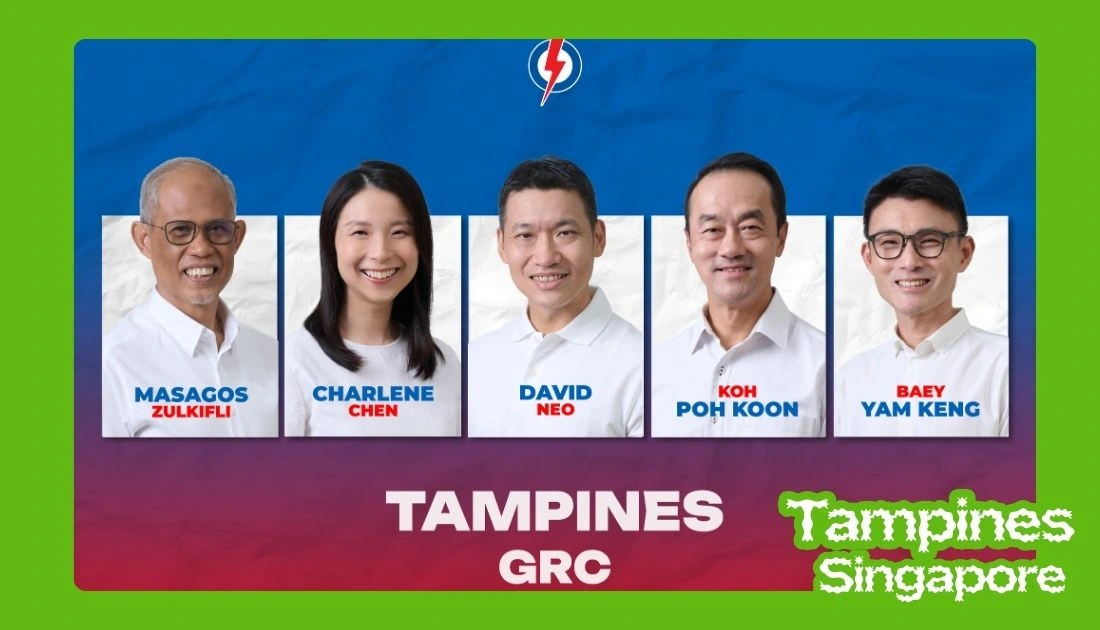
In the 2025 General Election, held on 3 May 2025, Tampines GRC underwent significant boundary adjustments. Part of the Tampines Changkat division was carved out, along with a polling district from the neighbouring East Coast GRC, to form the new Tampines Changkat Single Member Constituency, reducing the number of voters remaining in Tampines GRC itself. The PAP team for Tampines GRC, led by Minister Masagos Zulkifli and including Baey Yam Keng, Charlene Chen, David Neo, and Koh Poh Koon, won 52.02% of the vote against the Workers’ Party, the People’s Power Party, and the National Solidarity Party, a four-cornered contest and one of the tighter results the ward has seen in recent history. I’d present this as historical election data rather than draw conclusions from it about how residents currently feel, an election result tells you how votes were cast in that particular election, not necessarily what everyone thinks today.
In the newly created Tampines Changkat SMC, the incumbent Desmond Choo, previously representing the Tampines Changkat division within the GRC, contested and won the new single seat with 56.16% of the vote against the Workers’ Party’s Kenneth Foo.
Members of Parliament for Tampines GRC

Following the 2025 General Election, Tampines GRC is represented by a five-member PAP team:
- Baey Yam Keng
- Charlene Chen
- David Neo
- Koh Poh Koon
- Masagos Zulkifli
I’d always check the current Parliament of Singapore listing before relying on any older webpage, since a page can contain perfectly accurate historical information while still carrying an outdated “current MPs” section. This particular constituency is a good example of why that matters, Baey Yam Keng, for instance, previously represented the Tampines North division from 2011 before the 2025 boundary changes moved his ward assignment to Tampines Boulevard.
Brief Backgrounds
Baey Yam Keng has served as an MP for Tampines GRC since 2011 and currently also holds the role of Mayor of the North East District, with a background in community engagement and active mobility initiatives.
Charlene Chen was elected in 2025 as part of the five-member PAP team, having previously worked as an assistant professor and social and consumer psychologist. She was introduced as the new face for the Tampines East division ahead of the election, following Cheng Li Hui’s 2023 resignation.
Koh Poh Koon has served in Tampines GRC since 2020, having previously represented Ang Mo Kio GRC, and holds a background as a colorectal surgeon alongside his political roles.
Masagos Zulkifli, Minister for Social and Family Development, anchors the current Tampines GRC team as the lead candidate.
Desmond Choo previously served the Tampines Changkat division within Tampines GRC and now represents the newly created Tampines Changkat SMC as a separate constituency following the 2025 boundary changes.
How Representation Works Within a GRC
In Singapore’s GRC system, residents vote for an entire MP team rather than individual candidates, and if the party slate wins, all team members are elected to Parliament together. Within the GRC, each MP is generally assigned a specific ward where they handle local issues and resident engagement, while also collaborating with the rest of the team on constituency-wide initiatives like planning community facilities or coordinating large-scale events.
MPs work closely with grassroots volunteers to manage services such as infrastructure upkeep, social assistance programmes, and public outreach events, and residents can also engage through grassroots programmes at community clubs across Tampines. This structure means representation works on both an individual ward level and a collective, team-wide level at the same time.
Roles and Responsibilities of Tampines GRC MPs
At the national level, MPs from Tampines GRC take part in Parliamentary debates, sit on committees, and contribute to policymaking on areas like transport infrastructure, public housing, social welfare, education, healthcare, and environmental sustainability, voting on legislation and raising constituency-specific concerns during debates.
At the constituency level, MPs oversee town council matters, help ensure public estates are well maintained, and implement resident welfare schemes, including assistance for lower-income families or seniors. They organise regular town halls, Meet-the-People Sessions, and consultation meetings where residents can raise concerns directly, and they help coordinate between government agencies and local stakeholders on issues like maintenance requests or traffic safety.
Community engagement is a significant part of this work too, MPs conduct door-to-door outreach, take part in neighbourhood events like festivals and health fairs, and collaborate with volunteers on programmes supporting seniors, families, youths, and small businesses.
Meet-the-People Sessions
For residents, Meet-the-People Sessions are probably one of the most practical reasons to know which ward you belong to. These sessions let residents meet their MP directly to discuss personal or community concerns, from estate issues to social support matters, typically scheduled weekly at neighbourhood locations. Common cases handled include resident welfare, housing queries, estate maintenance concerns, community event support applications, and referrals to relevant agencies.
If I needed to attend an MPS, I’d check the current details before going, location, day, time, appointment requirements, and any documents I might need, rather than rely on an old blog post, since these arrangements can change. Residents typically book MPS slots ahead by phone or online, though walk-ins may be accommodated depending on availability, and it’s worth bringing identification and relevant documents for whatever the case involves. The Parliament of Singapore’s website currently lists specific MPS details for individual Tampines GRC MPs, and that’s the source I’d check directly rather than an older article.
Not Every Local Problem Is an MP Matter
Another practical point worth adding is that knowing your MP doesn’t necessarily mean the MP’s office is the correct place for every problem. Tampines residents may have questions involving housing, municipal services, transport, social assistance, or other government functions, and depending on the issue, the appropriate contact might be the town council, HDB, a specific government agency, or another service provider entirely. I’d identify what type of problem I actually have first, then check which organisation is responsible, rather than default to the MP’s office for everything.
Tampines GRC and the Wider Community Network
Beyond elections, I find the constituency interesting because of the network of community facilities around Tampines. Community clubs, residents’ groups, town services, schools, sports facilities, markets, parks, and shopping areas all contribute to everyday life in the town. When I explore Tampines, I notice that many places that seem unrelated at first are actually connected by the same neighbourhood network, understanding the constituency gives another layer of context to those places.
Being Careful With Historical Political Information
The historical side of a political page needs extra attention, since there are several different dates that can easily get mixed together. I’d distinguish clearly between when a constituency was created, previous constituency boundaries, past election results, changes in MPs, resignations or departures, electoral boundary reviews, the current constituency structure, and the most recent election. Keeping these separate is what makes an article trustworthy rather than presenting historical information as though it were current.
Keeping Personal Opinions Separate From Electoral Facts
Because this is a political topic, I think it’s especially important as a travel and local guide writer to separate what I observe from what I personally believe. If I’m explaining who represents Tampines, where an MPS is held, or what happened in an election, I want to give readers factual, sourced information. If I’m describing Tampines as a neighbourhood, I can talk about how its residential areas, community facilities, shopping centres, and transport connections fit together without telling readers how they should vote or what conclusion they should draw. That distinction makes the guide useful to people with different views.
Sources I Would Check Before Updating This Page
This is one page I’d make a habit of checking against official sources whenever I update it. For current MPs, that means the Parliament of Singapore. For election results, the Elections Department Singapore. For constituency boundaries, the latest official electoral boundary information. This matters especially after a General Election, since the composition of Parliament, constituency boundaries, and representative assignments can all change.
Frequently Asked Questions
What areas are under Tampines GRC?
Historically, divisions including Tampines North, Central, East, West, and Boulevard in eastern Singapore, though boundaries were adjusted in the 2025 General Election with the creation of Tampines Changkat SMC. I’d check the current official boundary map rather than assume the older ward names still apply exactly as before.
Who are the current MPs for Tampines GRC?
Following the 2025 General Election, the team is Baey Yam Keng, Charlene Chen, David Neo, Koh Poh Koon, and Masagos Zulkifli.
How do I find my MP in Tampines GRC?
Use your block or postal code on the official MP finder tool through Parliament of Singapore or Elections Department platforms to confirm your exact ward and MP.
Where can I see the Tampines GRC map?
Current electoral boundary maps are available through the Parliament of Singapore or Elections Department Singapore websites.
What does a Tampines GRC MP actually do?
They legislate in Parliament, represent constituents on national policy debates, address local resident issues through Meet-the-People Sessions, manage constituency programmes, and engage with the community through grassroots organisations.
My Overall Impression
For me, Tampines GRC is best understood as another layer of the town rather than simply a political name. When I explore Tampines, I usually think about practical things like where to eat, shop, relax, exercise, or get services. But understanding the GRC helps explain how parliamentary representation and local community engagement are organised across the area.
I’d encourage anyone researching Tampines GRC to start with their exact address, check the current constituency information, understand the difference between a GRC and an individual ward, and use official sources for current MPs and election details. Most importantly, I’d keep historical election information clearly separated from current constituency information, that small distinction makes a real difference when trying to understand how Tampines is represented today.