If I’m looking for a spacious, modern and genuinely family-friendly place to spend a few hours in eastern Singapore, Tampines Regional Library is one of the places I’d put on my list. Located inside Our Tampines Hub, it feels like much more than a traditional library. It combines books, study spaces, children’s areas, digital facilities and community programmes all in one large space — which is part of why I think it deserves a spot in a Tampines guide even though it’s not the kind of place most visitors think to look up.
What I particularly like about the concept is that you don’t have to visit only to borrow a book. Students can come here to study, parents can bring children for reading and learning activities, and adults can use the space for research, work, or workshops. It functions as a genuine multi-purpose community hub rather than a quiet room full of shelves.
The main reason I’d visit is the sheer variety of things available under one roof. It works equally well for a quiet study session, browsing books, bringing children somewhere indoors on a hot or rainy day, or joining a community learning programme. Because it sits inside Our Tampines Hub, I can also combine a library visit with dining, sports, or other community facilities in the same development, rather than treating it as a standalone errand.
For students, the study facilities are one of the biggest draws. For families, the children’s section makes the library considerably more interesting than a conventional quiet reading space. And for anyone just passing through Tampines who wants a break from the malls and food courts, it’s a genuinely different way to spend an hour or two.
A Bit of History: Singapore’s First Regional Library
Tampines Regional Library has an interesting place in Singapore’s library history. The original library opened on 3 December 1994 at Tampines New Town, and it was significant at the time for becoming Singapore’s first regional library, serving the local community for more than two decades from that original site.
The original library closed in June 2017 as part of redevelopment plans. The idea was to bring the library into the newly developed Our Tampines Hub and create a larger, more integrated community space rather than a standalone building. It reopened on 5 August 2017 at Our Tampines Hub with a completely modernised concept — larger spaces, upgraded facilities, new technology, expanded study areas, expanded children’s facilities, and community-oriented spaces that the original site never had.
So if you come across references to the “old Tampines Library,” that refers to the previous Tampines New Town location. The operational Tampines Regional Library today is the one inside Our Tampines Hub, and it’s worth keeping that distinction in mind if you’re searching for directions, since some older listings online may still point to the original address.
Interior and Overall Atmosphere
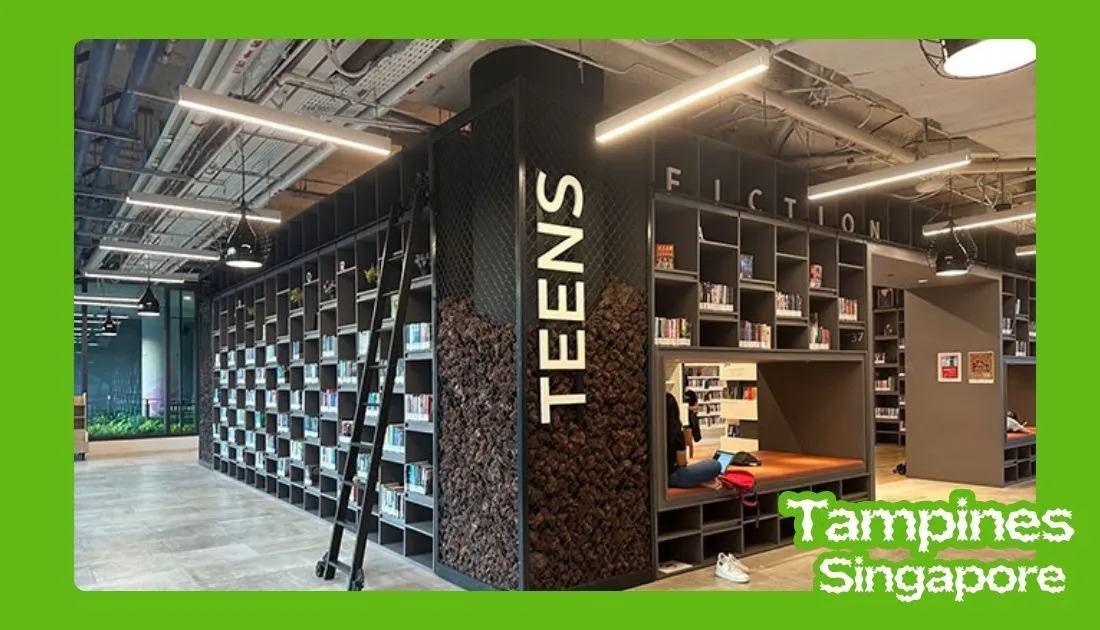
The first thing that stands out about the newer library concept is the open, modern layout. There’s natural lighting, wide walkways, and a genuine mix of seating styles rather than a single row of identical desks. Compared with the old library, the current space feels brighter, larger and considerably more interactive.
I also like that the library isn’t designed entirely around silent reading. Different areas serve different purposes, so there are spaces for collaboration and workshops alongside quieter zones for focused study. The library is divided into different sections for various age groups and activities, which helps prevent everything from feeling concentrated into one crowded area — something I think a lot of smaller neighbourhood libraries struggle with simply due to space constraints.
If I wanted to make a longer outing of it rather than just a library visit, I’d also consider pairing the trip with a walk through one of Tampines’ green spaces nearby, since the library alone is unlikely to fill an entire day unless you’re specifically there to study.
Study Areas and Workspaces
For students, this is probably one of the most useful parts of Tampines Regional Library. Secondary school, polytechnic, and university students regularly use the library as a study environment, particularly during examination periods when finding a quiet, reliable place to work becomes genuinely important.
What you’ll find here includes individual study desks for focused, solo work, long tables suited to group discussions, and more relaxed lounge-style seating for casual reading. Quiet zones are clearly marked to help maintain a conducive environment for people who need to concentrate, separate from the livelier sections of the building.
Power sockets are available in selected areas, though they can become limited during busy periods — worth keeping in mind if you’re planning to stay for several hours. Free Wi-Fi is provided throughout, which makes it convenient for research, online classes, or general remote work. If quiet study is specifically what you’re after, weekday mornings and early afternoons tend to be noticeably calmer than evenings, weekends, or school holiday periods, when the library understandably fills up much faster.
Wi-Fi, Printing and Self-Service Facilities
The free Wi-Fi throughout the building is genuinely useful if you need to research something online, attend a class remotely, or simply get some work done away from home. Beyond connectivity, the library also offers printing, scanning, and photocopying services, which are generally chargeable and managed through NLB’s own systems rather than a separate third-party provider.
Self-checkout machines and automated return stations are also available, which means members can borrow and return books independently rather than needing to queue at a staffed counter every time. Book drop services allow for convenient returns even outside opening hours, which is a small but genuinely useful upgrade compared with how the older library setup worked.
The Children’s Area
For families, the children’s section is one of the biggest reasons I’d recommend a visit. The space is designed specifically to encourage children to develop an interest in reading from a young age, with colourful seating, interactive reading corners, and dedicated storytelling areas built into the layout.
Books here are arranged so that young readers can browse easily on their own, while parents can remain nearby to supervise without hovering directly over every shelf. The indoor environment leans on child-friendly layouts and soft furnishings throughout. It isn’t a large playground in the way a shopping mall’s indoor play area might be, but the interactive learning spaces give children somewhere genuinely engaging to explore books rather than just sit and be read to. Storytelling sessions are also organised at certain times, giving families another reason to plan a return visit around a specific programme rather than just a general browse.
The Culinary Studio and Community Programmes
One feature that sets Tampines Regional Library apart from a smaller neighbourhood library is its dedicated culinary studio. This space allows the library to host cooking demonstrations and hands-on workshops, reflecting how modern public libraries have expanded well beyond being purely book-lending institutions.
Other programmes hosted here can include digital literacy classes, career talks, author sessions, educational talks, and skills-based workshops aimed at adults and seniors as much as children. Because the programme schedule changes regularly, I’d recommend checking the official NLB event listings in advance if a specific workshop or event is your main reason for visiting, rather than assuming something will be running on the day you show up. Many students from nearby primary schools also use the library regularly for research and revision, which gives you a sense of how embedded it is in the everyday routine of families in the area, not just as an occasional destination.
Collections and Digital Resources
As a regional library under the National Library Board, Tampines Regional Library holds a considerably broader collection than a smaller neighbourhood branch. Visitors can find fiction and non-fiction titles, children’s picture books and early readers, young adult novels, reference materials, magazines and newspapers, exam preparation guides, and a solid range of lifestyle, cooking, business and self-improvement titles.
Beyond the physical shelves, NLB membership also opens up digital resources — eBooks, audiobooks, and online databases accessible through NLB’s own platforms. That means even when you can’t visit in person, borrowing doesn’t necessarily stop. Self-service catalogue stations throughout the library also make it easy to check whether a specific title is available and exactly where it’s shelved, rather than wandering the aisles hoping to stumble across it.
Membership and Borrowing
To borrow physical books, you’ll need an NLB membership. Singapore citizens and permanent residents can register according to NLB’s standard policies, while foreigners may need to pay a membership fee to join. Once registered, members can borrow multiple books at a time, renew items online rather than returning in person, reserve titles held at other libraries within the NLB network, and access the full range of digital collections mentioned above.
Loan periods depend on the type of material borrowed, and late returns can result in fines, so it’s worth renewing online if you’re not going to make it back in time. The self-checkout machines make the whole process quick enough that borrowing rarely involves any real waiting.
Accessibility
The library has a genuinely inclusive layout, designed to accommodate elderly visitors, families with strollers, and wheelchair users without much friction. Wide aisles, lifts, and accessible restrooms make moving around the building considerably easier than in some older, more cramped library layouts, and clear signage throughout helps visitors find the right section without needing to ask staff every time — though staff are available to assist when needed.
When It’s Busiest — and When to Go Instead
If quiet study or a calmer visit is the priority, timing genuinely matters here. The library tends to be busiest after school hours from around 4pm onwards, through the evenings, on weekends, during public holidays, and especially during school examination periods when students descend on the study areas in large numbers.
Quieter alternatives are weekday mornings and early weekday afternoons — this is when I’d personally choose to visit if securing a study seat with access to a power point actually matters to your plans. During peak periods, seats can fill up quickly, so arriving early is the more reliable strategy rather than hoping something opens up later in the day.
A Few Practical Things to Know Before You Go
Bring your own charger if you’re planning a longer study session, since power points exist but can be limited during busy periods. Choose your section with the atmosphere in mind — the children’s area is naturally more lively, while the dedicated study zones are intended to stay quiet, so it’s worth sitting in the right one for what you actually need. Standard library etiquette applies throughout: keep your phone on silent, avoid eating inside, and supervise children at all times, particularly around the more interactive areas. And if a specific workshop or programme is the reason for your visit, check the schedule beforehand, since some activities require registration in advance.
My Final Take
Tampines Regional Library stands out because it’s successfully moved beyond the traditional idea of what a library should be. For me, its biggest strengths are the large collection, genuinely useful study areas, well-designed children’s facilities, free Wi-Fi, digital resources, community programmes, and its convenient location inside Our Tampines Hub, which means a library visit rarely has to be a standalone trip.
Its history also makes it worth knowing about beyond the practical details. It began in 1994 as Singapore’s first regional library, closed for redevelopment in 2017, and returned as part of Our Tampines Hub with a far more modern and community-focused concept than the original building ever had. If I were planning a visit, my own preference would be a weekday morning, particularly if a quiet atmosphere or a guaranteed study seat matters to the trip. For families, I’d check the programme schedule beforehand and build in enough time to actually explore the different sections rather than rushing through. cooperates.